New Specialized Heart Procedure Safely Removes "Leads"
December 22, 2025
On November 17, HSHS St. Elizabeth’s Hospital performed our first laser lead extraction. This innovative, specialized heart procedure is used to safely remove old or damaged wires, called “leads”, from a patient’s pacemaker or defibrillator.
The first laser lead extraction at HSHS St. Elizabeth’s Hospital was performed by Dr. Michael Hushion, Prairie Cardiovascular Electrophysiologist. “Laser lead extraction is a minimally invasive procedure that allows us to update or replace life-saving heart devices while protecting the patient’s heart and minimizing risk,” shares Dr. Hushion. “Being able to perform this procedure at St. Elizabeth’s Hospital means patients can receive this specialized care close to home, without needing to travel into St. Louis.”
Leads are the wires that delivers energy from a patient’s pacemaker or defibrillator to their heart to help maintain a steady heart rhythm. After the initial pacemaker is implanted, scar tissue forms and builds gradually, securing the lead in place. Over time, these leads can stop working properly or may need to be replaced due to infection, breakage or device upgrades.
“By removing damaged or infected leads, patients can experience improved device performance, which supports better heart rhythm management and overall cardiac function,” shares Dr. Hushion. “Removing these leads also eliminates potential sources of infection.”
With laser lead extraction, a cardiac electrophysiologist uses a thin, laser-powered sheath that gently breaks down scar tissue surrounding the lead so it can be removed without pulling on the heart. This technology allows for precise, controlled extraction and is considered the safest and most effective method for difficult or long-standing leads.
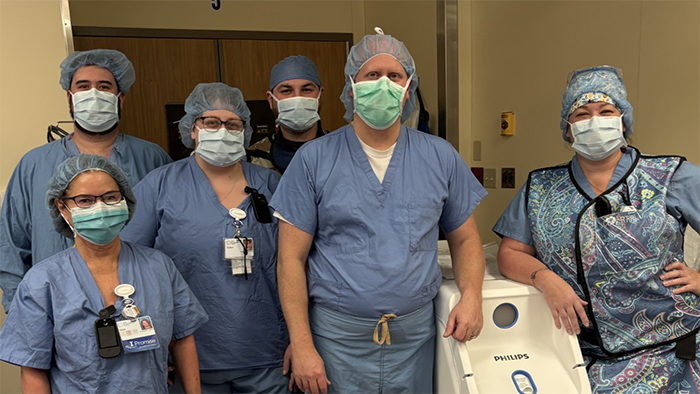
Photo Caption: Dr. Michael Hushion, Prairie Cardiovascular Electrophysiologist performed the first laser lead extraction at HSHS St. Elizabeth’s Hospital.
The first laser lead extraction at HSHS St. Elizabeth’s Hospital was performed by Dr. Michael Hushion, Prairie Cardiovascular Electrophysiologist. “Laser lead extraction is a minimally invasive procedure that allows us to update or replace life-saving heart devices while protecting the patient’s heart and minimizing risk,” shares Dr. Hushion. “Being able to perform this procedure at St. Elizabeth’s Hospital means patients can receive this specialized care close to home, without needing to travel into St. Louis.”
Leads are the wires that delivers energy from a patient’s pacemaker or defibrillator to their heart to help maintain a steady heart rhythm. After the initial pacemaker is implanted, scar tissue forms and builds gradually, securing the lead in place. Over time, these leads can stop working properly or may need to be replaced due to infection, breakage or device upgrades.
“By removing damaged or infected leads, patients can experience improved device performance, which supports better heart rhythm management and overall cardiac function,” shares Dr. Hushion. “Removing these leads also eliminates potential sources of infection.”
With laser lead extraction, a cardiac electrophysiologist uses a thin, laser-powered sheath that gently breaks down scar tissue surrounding the lead so it can be removed without pulling on the heart. This technology allows for precise, controlled extraction and is considered the safest and most effective method for difficult or long-standing leads.
Photo Caption: Dr. Michael Hushion, Prairie Cardiovascular Electrophysiologist performed the first laser lead extraction at HSHS St. Elizabeth’s Hospital.