

Attention Under maintenance, some page elements may not display correctly. We appreciate your patience.

Ion Bronchoscopy

Flexibility for your lung biopsy.

Active senior African-American man outdoors Active senior African-American man outdoors.
Ion bronchoscopy machine

About the Procedure

If your physician found a spot on your lung, commonly called a nodule or small mass, he or she may recommend you have it checked out further. This test is called a lung biopsy. Fewer than 5% of nodules are actually cancer, but your doctor may recommend you find out for sure.

HSHS St. Elizabeth’s Hospital offers Ion bronchoscopy, a minimally invasive surgical procedure to perform lung biopsies. Ion bronchoscopy uses a robotic-assisted system to examine the lungs and obtain biopsies from hard-to-reach areas. 

Overall, Ion bronchoscopy represents a significant advancement in pulmonary medicine, enhancing the ability to diagnose and treat lung diseases effectively. 

Your doctor may recommend this procedure if there are suspicious nodules or lesions in your lungs that need further evaluation, especially if they are difficult to access with traditional bronchoscopy.
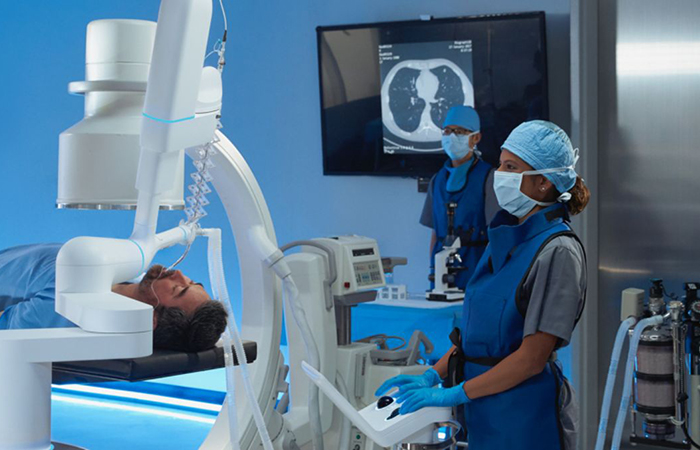
Benefits

  • Increased Accuracy: The robotic system reduces the risk of complications and improves the likelihood of obtaining adequate tissue samples.
  • Less Invasive: The procedure is minimally invasive, leading to reduced recovery times and less discomfort for patients.
  • Real-Time Imaging: Physicians can visualize the bronchial structures in real-time, allowing for better decision-making during the procedure.

Frequently Asked Questions

You can get a heart test at an HSHS location for $100 plus tax.

You have the option to use your flexible spending account (FSA), health savings account (HSA) or health reimbursement arrangement (HRA) to pay for calcium scoring.

We recommend contacting your health insurance to confirm if and how much they cover for the calcium score test. You can also estimate the cost of procedures with the MyHSHS price estimation tool.

Referral requirements vary by state and location.

We recommend contacting your primary care provider before you schedule a heart scan. You can call them directly or message them in MyHSHS or MyPrevea.

Need a primary care doctor?

The calcium test is simple and takes about 15 minutes. You lie down and let the CT scanner do the rest. The procedure is non-invasive — with no injections or radioactive dyes.

After you schedule your scan, you’ll receive instructions on how to prepare for your test. Our diagnostics team is also here to answer any questions.

You usually receive your calcium score results on the same day of your scan or within 24 hours. Results are available through MyHSHS or MyPrevea. We also call you and schedule follow-up care if needed.

A calcium score is usually on a scale of zero to over 1,000. The higher the number, the more calcium buildup there is in the heart. A higher number also means a higher risk of heart attack.

Any number over zero is a positive test. Usually, a calcium score of 100 or less means mild coronary artery disease. A score above 400 is more severe coronary artery disease.

If you have a high calcium score, you may be at a higher risk of heart attack. Your provider will look at your score along with other factors. They'll work with you to see if you need additional imaging scans or treatments to prevent a heart attack.

Talk to Your Health Care Provider

If you have any other questions or concerns, it’s important to discuss them with your health care provider, who can provide personalized information based on your specific situation.

Find a Provider Near You