
In this video, Courtney describes the life changing moments that ultimately led her to HSHS Wisconsin Clinical Research Institute, which provides patients at HSHS St. Vincent Hospital Cancer Centers access to world class clinical trials and research.
Courtney’s Story
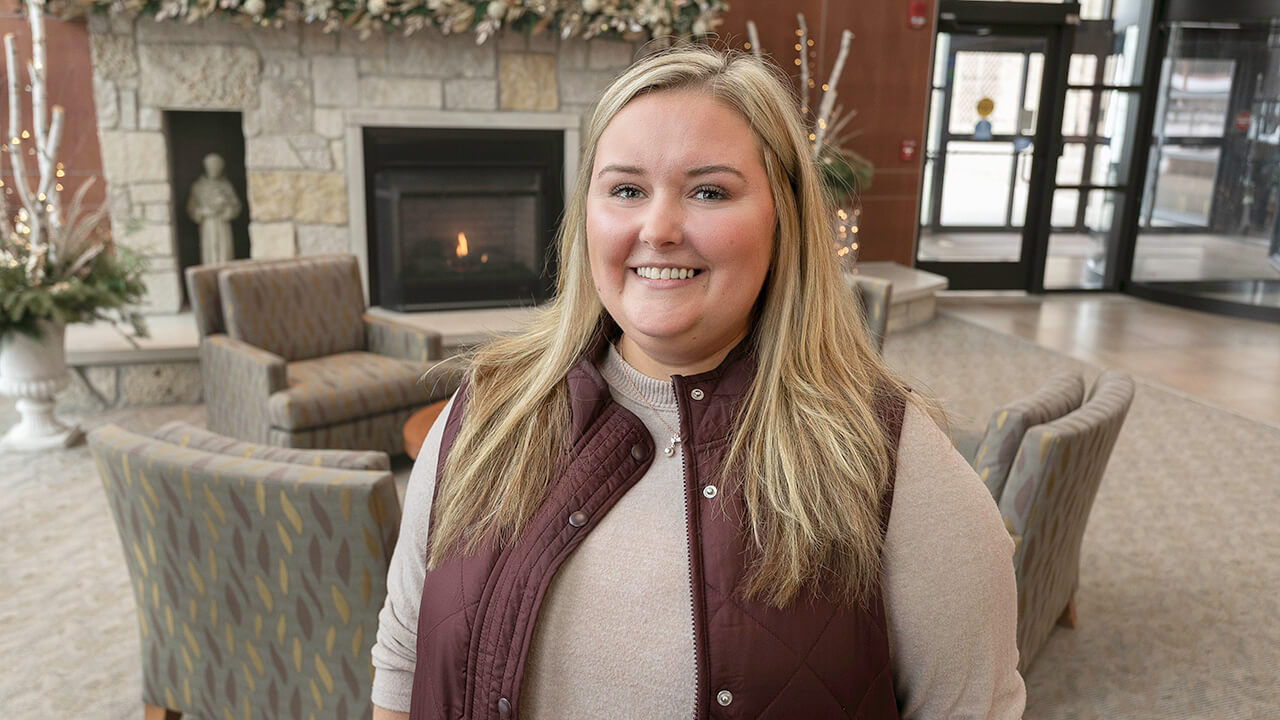
Living With Smoldering Multiple Myeloma: Why a Clinical Trial in Green Bay Felt Right
At the age of 31, Courtney never expected a routine rheumatology appointment to change everything.
The Manitowoc native saw her rheumatologist every six months for ankylosing spondylitis, which includes regular lab work.
“These labs that the doctor had drawn, they were just routine,” she said.
However, results showed an elevated amount of protein in Courtney’s blood. This led her rheumatologist to refer her to a local oncologist, who confirmed the blood work concerns and performed a bone marrow biopsy to get a definitive answer.
The phone call that followed is one Courtney still remembers as the hardest moment in this journey.
“March 10 is when the oncologist called me to say my preliminary results showed I had multiple myeloma. He told me that I’d likely need to start chemo and radiation and receive a stem cell transplant. That date will always stick with me,” she said.
Further testing over the course of the next two weeks revealed Courtney’s official diagnosis was smoldering multiple myeloma with high-risk features.
What is Smoldering Multiple Myeloma (SMM)?
Smoldering multiple myeloma is a blood and bone marrow disorder marked by elevated levels of a monoclonal protein in the blood, which are produced by an abnormal plasma cell in the bone marrow. While it’s not cancer and it doesn’t cause any symptoms, Courtney had a 60-to 80 percent likelihood of developing symptomatic multiple myeloma – a rare blood cancer – with damage to her organs over the next five years.Seeking Multiple Opinions
SMM typically affects people over age 60, so Courtney’s case is unique. As they began meeting with specialists, Courtney and her husband needed clarity and options.They first visited a specialist in Milwaukee where Courtney remembers learning that because smoldering multiple myeloma isn’t cancer yet, the standard of care is to not pursue treatment until symptoms like kidney damage, bone lesions, high calcium or anemia develop.
“The doctor said, ‘We could monitor you, but there’s nothing else that we can do,’” she said. “And my husband didn’t like that answer. So, we kept going.”
Their journey to find more answers continued onto Madison and Rochester, Minnesota. Along the way, they learned about a clinical trial that would be the answer they needed. Then came even better news.
The HSHS Wisconsin Clinical Research Institute in Green Bay had the smoldering multiple myeloma clinical trial open, less than an hour from home. This helped make the idea of participating in a clinical trial more realistic for everyday life.
“Game changer,” she said. “I didn’t realize that it could be that close.”
Why a Clinical Trial Felt Right
Since Courtney was at high risk for developing multiple myeloma, she was eligible to enroll in the clinical trial.“I decided that being so heavily monitored was better than just, ‘Well, we’ll try some things and see what happens,’” Courtney said. “It was the security of knowing somebody’s watching everything that I’m doing.”
She remembers how one of the specialists she saw explained the bigger picture to her.
“She said, ‘You’re on a train and we are trying to keep you on that train as long as we can before you hit the train stop. If we can suppress the growth of lesions and cancer cells, that will be long-term your best option.’”
Ultimately, three things helped her commit to the clinical trial for SMM: access, close monitoring and practical support.
Paying for the medications also weighed on her.
“A lot of insurance companies won’t cover it,” she said of a key medication at her stage. “But if I do this trial, it’s covered. You know, why don’t I just give it a shot?”
Access to Clinical Trials in Green Bay Made the Difference
Through it all, Courtney has leaned on structure and support, including the research team guiding what’s allowed within trial guidelines.“They basically have a ‘bible’ of this trial,” she said of the HSHS Wisconsin Clinical Research Institute. “They’ve been very good at getting me whatever information I need.”
Today, she’s in a steady rhythm, coming to Green Bay for labs and monthly check-ins. The convenience has mattered more than she expected, especially since she’ll need to complete 24 four-week cycles of the trial drugs.
“It makes it manageable,” she said. “I’m only leaving work an hour early.”
Instead of an all-day trip to Madison or Minnesota, her care is within reach.
“I do not feel like I am getting any less care here in Green Bay than I would at a larger academic medical center,” she said.
Living With Smoldering Multiple Myeloma at a Young Age
If there’s one thing Courtney has worked hard to protect, it’s her identity outside of the diagnosis.“This is never gonna go away,” she said. “This is gonna be a lifelong thing, so why let it completely control my life? I still have to live.”
This determination, coupled with support from her loved ones, helps her through even the most challenging times.
“I feel lucky to have full support from all my family and friends,” Courtney said. “My sister is in the medical field, so she’s been my go-to for questions or just a comforting chat. My sister-in-law did apparel sales to help cover some of my medical costs. My parents and father-in-law are always checking in on me and asking how I’m doing. My mother-in-law has come to all my appointments. And my husband has been my daily support through the rough days.”
For anyone newly diagnosed and overwhelmed by the first wave of fear, Courtney’s advice comes back to information, persistence and choice.
“I heard cancer and I instantly thought, ‘I’m gonna die,’” she said. “But getting all of the information that’s out there, it made me realize there’s hope.”
She encourages people to seek a second — or third — opinion.
“Educate yourself, figure out all of your options, don’t just settle,” she said. “Figure out what’s going to be best for you.”
And for her, best has meant staying as steady as possible, for as long as possible with a plan that feels proactive and close to home. Looking ahead, she’s hopeful for what the clinical trial could help her achieve.
“I hope my numbers will just keep continuing to decrease,” she said, “and by the end of the trial, we can just go into monitoring for many, many years.”
Additional Clinical Research Information
You can learn more about the clinical trial Courtney is on, EAA 173 / DETER-SMM, here.To learn more about the HSHS Wisconsin Clinical Research Institute and browse all current open clinical trials offered at HSHS St. Vincent Hospital Cancer Centers, click here.
Categories:
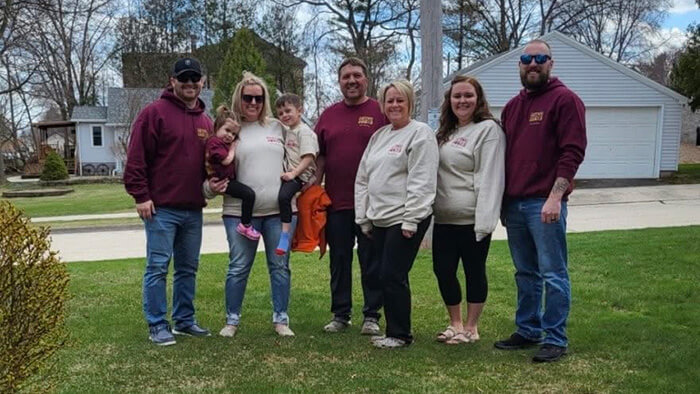
Family support
Courtney, second from right, poses for a photo with her husband and his family in their custom apparel supporting Courtney's journey.
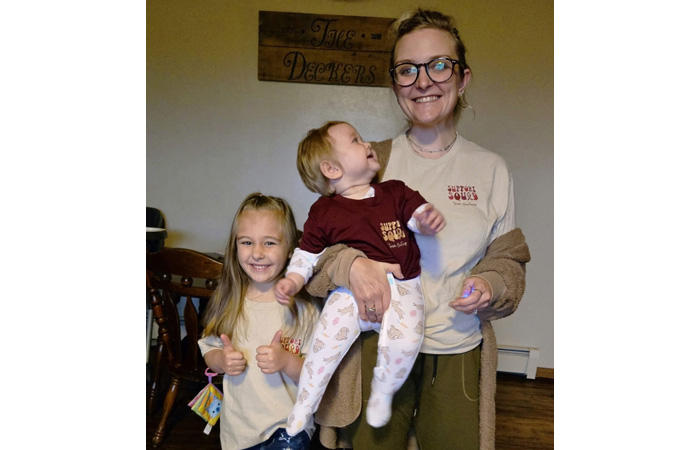
Apparel for a cause
Courtney's sister and nieces model the apparel they purchased to help cover medical costs.

Fluffy moral support
Courtney's dogs, Henry and Nova, are always near for fluffy moral support.